
Trainer
Certification Course
Join a community of Spirit-led facilitators who guide churches toward supernatural breakthrough and strategic growth.
Equipping Leaders. Empowering Churches.
Access the online certification course here! Find tips and best practices on how to effectively lead an Acts 2 Journey Cohort. This course is designed to give you the skills to help pastors and teams find success – crafting a path forward through the cohort and beyond.

Introduction: Lessons 1-4
1. Introduction: Acts 2 Facilitator Certification Course

Read This First
Thank you for your interest in becoming an Acts 2 Facilitator. The following course invites you to consider some of the unique challenges involved in facilitating an Acts 2 Journey Cohort and to reflect on your own experiences that not only qualify you as a facilitator but also equip you to help churches reach their next-level potential.
- What kinds of churches take part in a typical Acts 2 Journey cohort?
- What feelings might pastors and teams have when they come to Retreat 1? When they leave?
- What is the difference between a vision-based leader and a values-based leader, and how can you help both types discover God’s vision for their church?
- How will you lead the pastors and teams relationally?
- What are the components of an effective vision?
The Acts 2 Journey is a biblical, foundational template for church health endorsed by the Assemblies of God. As such, the Acts 2 Journey does not seek to replicate what may have worked in the past for a potential facilitator in his or her given setting. However, as a potential facilitator, your unique blend of experiences and leadership ability will be invaluable resources to draw upon for the churches you lead in the Journey.
The following exercises deal with the crucial role the facilitator plays in helping teams find God’s vision for their churches. At Retreat 1 and throughout the Journey, facilitators will have to find ways to stir thinking and touch the hearts of the leaders with whom they interact.
As you work through the material, consider the makeup of the teams you’ll lead and what you might add to the vision, values, and strategy development conversations.
2. The Makeup of a Typical Cohort
Read This First
On Saturday of Retreat 1, the room is filled with wonderful people who want to see God do something in their church. Some of them have been waiting a long time.
- They might have cycled through half a dozen pastors with their half a dozen different visions.
- They might be in a place where they feel as though they have tried it all (when in reality they might not have tried that much.)
In 2018, more than 70% of AG USA churches were plateaued or in decline, while less than 30% met the definition of a growing church. Much of the growth occurs at the top end among our largest churches.
In 2020, the number of plateaued and declining churches topped 80% for the first time ever. You'll find the expanded 2022 breakdown of AG USA's growing-plateaued-declining churches available for download below.
Often, the growing churches are not those in the room on an Acts 2 Journey cohort Saturday session.
Those sitting in the room with their teams might view the facilitator with a mixture of skepticism and hope. Many times, the facilitator will have the advantage of an existing relationship with the pastors or teams that you lead. Other times, he or she might not have that advantage.
Regardless of a facilitator's previous interactions with these churches, it's important to keep in mind that
while the facilitator's personal story will be an important part of how he or she presents, the goal is
not
to recreate it in other churches. Instead, the facilitator's goal is to help each church discover (or rediscover) their story with what new things God has for their church in their context.
Watch Video
Complete Assignment
Please upload your response to the following question before beginning the next lesson:
What experiences have you had in ministry that you could draw upon to assist leadership teams in discovering God's vision for their church?
3. The Job of an Acts 2 Facilitator
Read This First
Because of potential facilitators' roles of leadership and experience working with churches, it’s easy to look at difficult church situations with a divided focus—one eye might be on the church while the other eye searches through our tool kit looking for ways to fix the problem.
Before reaching for a “fix,” an Acts 2 facilitator must first love and believe in the church. In many cohorts, there will be Vision Team members (and perhaps even lead pastors) who don’t believe that a better day is possible for the church.
- Some pastors might even be attending a cohort because the district mandated that their districted affiliated church attend. While it’s good to have such churches in our midst, facilitators can face an uphill battle when working with these pastors, deacons, and leaders who might be present against their will.
- Some leaders have been through other conferences and events that have left them feeling frustrated.
Acts 2 Journey facilitators are there to help, bring a template, and give direction, but if the facilitator doesn’t believe, some will leave the room not believing.
From the perspective of the facilitator, the Acts 2 Journey is as much about helping people to believe as it is knowing what to do in a particular set of challenging circumstances.
Facilitators should make every effort to see things from the perspective of the churches they're working with—not just from the pastor's point of view, but from the point of view of the team members.
Begin by believing. Getting this step right will affect how you present and everything you do. Begin by loving them, and let the issue of leading them develop naturally. It's their journey, not just yours!
Watch Video
Complete Assignment
Please upload your response to the following question before beginning the next lesson:
Describe a time when you helped people believe for a new day in the face of a challenging current reality. How do you plan to leverage your role as an A2J facilitator to instill in teams a belief that a new day is possible?
4. Life Cycle Stages of Congregational Development
Read This First
At Retreat 1, teams are invited to complete a short assessment based on their perspectives of their church's current reality. Team members complete the assessment individually. The results of the assessment will determine where each team member sees the church on it's life cycle.
Results of the assessments may differ, even among members of the same team. For instance, those on the team who recently experienced life transformation at the church or who have been mentored by the pastor through a difficult time might see the church in a different light than a team member who has been at the church for decades.
The life cycle exercise has at least three purposes:
- To generate discussion among team members about their perspectives on the church without assigning fault or blame (with the pastor present and listening)
- To help the team reach a consensus about the church's place on the life cycle and understand the dynamics present in the particular life cycle stage
- To help the team see the contrast between when vision and relationships (ascending side) are driving the church and when programs and management are driving the church (descending side).
Ultimately, the facilitator's goal is to help the team see that regardless of where the leadership sees the church on its current life cycle, building a new life cycle is possible through the infusion of fresh vision and the development of new relationships.
Facilitators should possess a working knowledge of each life cycle stage. However, the overarching sense that teams must clearly understand and articulate together at the conclusion of this exercise is simply this:
We know where we are, and we know that we can't stay here.
Watch Video
Complete Assignment
Vision Development: Lessons 5-10
5. Helping Teams Develop Vision
Read This First
Let’s talk about vision from your vantage point as potential facilitators.
How important is vision? When a church has been locked into a way of doing things, the only way to shake them out of that is fresh vision.
The Acts 2 Journey team has found that lost vision is the primary cause of plateau in the church. Studies demonstrate that to be true. When lost vision happens, inward focus happens, which precipitates the decline. The Acts 2 Journey team believes that the strategies a church will build won’t amount to much without a fresh vision.
Most churches realize there’s a problem when they’re on the back side of the life cycle. At that point, they’re looking for a new program, a new idea—something they can do to stop the bleeding. The problem on the back side of the life cycle is not a lack of programs. It’s a lack of vision.
The truth is that programs without vision are just a whole lot of work. Unfortunately, churches can get trapped in this cycle: try a new program, maybe a little bump for a moment, but because there’s no new or clear vision, they’re back to where they were, and they get a bumpy ride on the decline. They’re looking for the magic bullet when the truth is what has to happen is a fresh vision.
In the vision segment of the retreat, lead folks to answer the question, “Where are we going?” After talking about what vision is, what it can do, and what are its sources, the facilitator has to help those who have never been in this pursuit discover what God wants for the congregation.
In the Acts 2 Journey cohort, the following distinction is made between the terms mission and vision:
- Mission is defined as the universal assignment; the Great Commission and Great Commandment.
- Vision is defined as the unique expression of that assignment for the congregation. It’s what they were made to do, what God designed them to do.
Watch Video
6. Finding Vision: Insights from the DiSC Profile
Read This First
It is quite likely that four out of five of the leaders in the room at a typical Acts 2 Journey retreat are not naturally vision-based leaders. They’re leaders, but their understanding of leadership does not flow naturally from a vision base.
Conversely, potential Acts 2 Journey Facilitators are likely vision-based leaders because of the roles they serve in and the opportunities that they’ve taken advantage of.
Statistically, about 80% of pastors are not vision-based leaders, which are D and I types on the DiSC profile. They are values-based leaders, which are S and C types on the DiSC Profile.
Action-oriented personalities see a problem and immediately know how to take action. These personalities are more comfortable leading from a vision base.
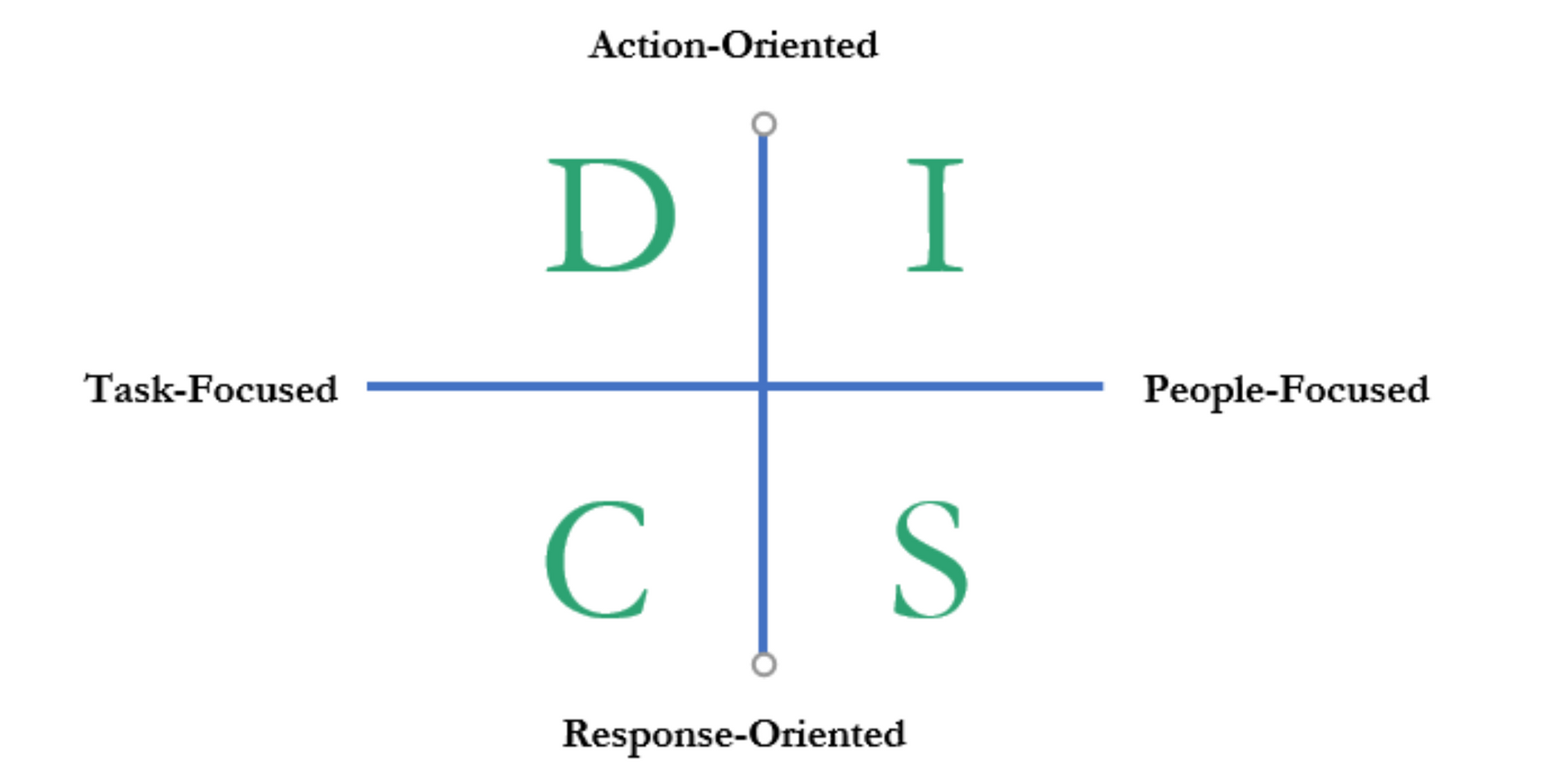
Response-oriented personalities are more comfortable having someone else step forward, and they’re willing to help. What’s fascinating is that when it comes to local church pastors, 80% are below the horizontal line in the above chart. These are S and C leaders. Part of our challenge in these settings is that we’re trying to lead people in a process that is not natural to them or is even intimidating to them.
Watch Video
Complete Assignment
Please upload a file in response to the prompt before continuing to the next session:
What is your DiSC type? Describe how your temperament has helped shape you as a leader.
7. Characteristics of Values-Based Leaders
Read This First
Many intuitively understand how to take charge with a strategy that will effectively address a problem, but many pastoral leaders aren’t wired that way. That fact can make vision development especially challenging. Many pastors are values-based leaders.
D and I personalities are more naturally vision-based. D is task-oriented and strategic, I is motivational and people-oriented. They operate differently, but vision comes naturally for both of these leadership styles.
When you’re talking vision, some will think you’re talking their language, but you’re not talking everyone’s language. S and C pastors often go home from conferences and events frustrated after listening to D and I leaders.
S and C are relational leaders. The C is an ethical leader. They lead from a different base and do things because “it’s the right thing to do.” When you get to values, these leaders will shine while your vision-based leaders might not have patience for that process.
The role of pastor is one of the few career paths where all four personalities can be a part of and anticipate success. It’s a unique reality of the kingdom of God. If I’m looking for a car salesman or an accountant, I know which type I need, and they’re not the same. If you’re a superintendent looking out on your pastors, you see them all over the map.
As a facilitator, you have got to get at what’s inside the hearts of pastors and team members. You have to find what makes them come alive. Values-based leaders can cast vision and lead from a passion base, but you have to help them tap into their passion.
The document that Mike Clarensau refers to in the above video provides further insights into the values-based vs. vision-based contrast and is available for download below.
Watch Video
8. Helping a Church Find Its Engine
Read This First
Acts 2 Journey facilitators must communicate the belief that God’s vision for every church is already in the room on Saturday.
God’s vision for the church is beyond our own capacity, but God is going to use the passion and the abilities of the church. Then, what are the needs of the community? If a church can find this first one, the other two often fall into place.
Where passion and ability and need come together, a church can find the engine to drive forward.
A significant concern when leading an Acts 2 Journey is that a church will bring a statement of vision that means nothing to them. The statement might sound good, or look like another church’s, but it doesn’t mean anything. In these cases, the vision statement becomes something to put into a bulletin or a banner, but it doesn’t have the power to lead them to a new day. Values-based leaders need help getting there. It’s about picking at their passion.
How could you do that? Maybe it’s something from your own journey or story that helps you to relate to the teams in the room. The Acts 2 Journey provides resources for the vision conversation, including "The Amanda Game" and "The Power of Your Story" discussion exercises.
If the teams' hearts are not in it,
they’re not going anywhere, no matter how great the plan is.
Watch Video
Complete Assignment
Please upload your response to the following question before beginning the next lesson:
Describe a time when you have led a team to discover vision.
*You must upload the required file to complete this lesson. (Accepted formats: pdf, docx, doc.)
9. Vision Activity: The Amanda Game
Read This First
The way the Acts 2 Journey helps leadership teams identify their passion is through an activity called the Amanda game, which is described in the above video. Many S and C leaders can identify with this story.
The purpose of this activity is to demonstrate that for many in the room, the only way they're going to get God’s vision for their church is by looking in the eyes of people.
They won’t find it in their office, and maybe not even in their prayer closet.
Facilitators should lead two activities during Retreat 1 to help teams develop vision:
- Invite teams to take turns playing this game with those at their table. The assignment between Retreats 1 and 2 is to have teams continue playing the game individually between retreats to see what themes keep coming up.
- Invite teams to participate in an exercise called "The Power of Your Story." This exercise is designed to help them share their stories with one another in no more than three minutes. Because churches often rate evangelism as the weakest of the five functions in the life of their church, this exercise helps re-frame and strengthen the practice of evangelism as teams share their stories and identify their collective passion.
Watch Video
10. Creating Vision Statements
Read This First
Think about how to access pastors' and teams' passions. Whatever is in their hearts, regardless of limitation, that pastor can lead that. He or she has been designed to lead it, and there are people who will surround the leader and facilitate that vision.
Facilitators should not be content with clever phrases that don't seem to resonate with what is in their hearts. If it’s not there, it won’t move them forward.
Vision leaders are adept at raising an army and moving it forward. They work through this process in a natural way, but four out of five in the room are not that person. You might consider encouraging them to bring a report of their Amanda game to their team meetings. How many times did you play it? What kept coming up?
Somewhere in the collective sense of what’s in their hearts, they’ll discover God’s vision for their church.
Don’t settle for cool statements. It’s not the words in the statement; it’s how they say them. When a church says, “Here’s our vision,” the A2J facilitator should ask, “Why?” If they find that answer, the next steps are much easier and they build a strategy toward a future they’re meant to live out.
Don’t fall into the trap of thinking the leaders in front of you function like you do. They can’t run with what you’ve run with.
This isn’t about a single individual hearing a voice; it’s about a group getting a collective sense of what God has for them. It’s possible to arrive at a vision statement too quickly. Vision statements should contain more than just internal language. The goal should be to craft a vision statement that unchurched people can hear and say, “Yeah, that sounds like what a church should be about.”
Again, because churches often rate evangelism as the weakest of the five functions, challenge teams to consider the role of outward focus in the vision statement.
Watch Video
Core Values Development: Lessons 11-12
11. Facilitating Core Values Discussion
Read This First
The conversation among leaders about the negative values that are being demonstrated at the church occurs during Retreat 2. As you might imagine, this conversation carries significant risk.
Facilitators should keep in mind that the assessment work that teams completed during Retreat 1 has prepared them to have difficult discussions like this.
Facilitators are encouraged to keep an eye and ear out for discussions that might be turning the corner toward hostility. Talking about values exposes the culture of the church, which can create significant tension when the unhealthy behaviors being discussed might be linked to team members who are seated around the table on Saturday.
Teams tend to get stuck in the core values discussion, and some extra hand-holding from the facilitator is required. It's important not to assume that teams always understand what's being asked of them.
In the best-case scenario, the facilitator will be available for phone calls and follow-up consultations between retreats to help the team along if they get stuck.
One of the primary reasons the Acts 2 team has opened up the opportunity for mentor certification is to empower more leaders to help pastors and teams through the difficult stages of implementing the process, especially those who experience significant headwinds when implementing the process.
As a facilitator, do as much as you can in the time you have to ensure teams understand what's expected of them. Do your best to create an atmosphere where teams can ask questions, admit vulnerability, and express a need for extra assistance.
Sometimes, attending the between-retreat team meetings is the most productive time to address areas of confusion because there might be less hesitation to voice concerns in a setting in which only one church is present.
Watch Video
Complete Assignment
Please upload your response to the following question before beginning the next lesson:
Describe a time as a pastor or district leader when you led a team that was experiencing conflict. How did you find resolution? How might you draw upon these experiences as an A2J Facilitator?
12. Guiding the Creation of Core Values
Read This First
If tables are having difficulty understanding core values, facilitators might want to be more prescriptive with core values, perhaps even prescribing a formula (a two-word core value followed by a descriptive sentence and a Scripture reference for support.) Examples can be found in the participant handout and PowerPoint.
Typically, churches should create 5-9 core values statements.
Some team members might be anxious to move past values into discussions on how to "fix" things that they perceive are broken in the church. Reassure these team members that the strategy discussion will come at Retreat 3.
For now, the focus is on the priorities and behaviors that the church needs to understand and model in order to live the vision.
Watch Video
Complete Assignment
Please upload your response to the following question before beginning the next lesson:
Share some core values that you have developed and established for your own life and ministry.
Strategy Development: Lessons 13-15
13. Congregational Strengths
Read This First
Where
passion and
ability and
need come together, a church can find the
engine to drive forward. With this in mind, strategy discussions in the Acts 2 Journey begin with helping a church discover its abilities--the strengths the congregation already possesses.
In many smaller settings where leaders might consider their people resources scarce, a foundational step is inviting the congregation to discern what they already do well.
While there are likely weaknesses in the congregation that must be addressed in order for them to move forward, beginning with weaknesses often requires more effort and produces fewer results. Instead starting with fixing the areas where a congregation is weak, help them to consider one current strength that the congregation already possesses.
Next, invite them to consider how they might deploy this strength outward instead of inward. Often, what a church does well is visible only to those who already attend that church. People resources are pointed toward inward-focused service and participation, often resulting in a high percentage of the congregation serving without seeing the fruit of others coming to know Jesus.
Invite teams to consider how the congregation's strengths and their individual gifts and callings might align to give birth to fresh strategies.
The video below provides one such example.
Watch Video
Complete Assignment
Please upload your response to the following question before beginning the next lesson:
Describe a time when you have led a team to discover its strength and deploy it outward toward the surrounding community.
14. Facilitating Strategy Discussion
Read This First
Retreat 3 involves walking teams through the remainder of the Ten Questions:
- How will we engage new people?
- How will we treat them when they arrive?
- How will we disciple them?
- How will we train them to serve?
- How will we involve them in missions (local, global, and personal)?
- How will we help them encounter God?
These questions can be addressed in whichever order seems most natural, as long as each one is addressed. The goal is to stir the thinking of teams in the room. While facilitators should draw from their own experiences, they should help teams see how each strategy might take shape in their own church and community context.
The strategy discussion at Retreat 3 moves beyond merely slotting what the church already does into “systems.” On the contrary, teams should experience the guidance of the Holy Spirit as they consider how best to engage their communities.
Watch Video
15. Communicating in Times of Change
Presenting the Plan as a Team: Session 5 Introduction
Prior to Retreat 4, teams should develop a draft of how they’ll present their strategic plan to the church.
Following Retreat 4, teams will choose a launch Sunday to share their presentation with their church.
Here are some things facilitators should encourage teams to consider as they develop their presentations:
- Don’t list every strategy step. Sharing a list of items might overwhelm a smaller congregation.
- Stir hearts by highlighting community need. The goal of the presentation is to generate congregational buy-in to engage the surrounding community.
- Make the team visible. Reinforce for the congregation that a team has been involved in the process.
Prior to presenting to the entire congregation, pastors should consider the sequence and timing of communication to other key leaders beyond those participating on the Acts 2 Journey vision team.
Encourage pastors to consider the following breakdown of groups within their congregation and give special attention to how they will prioritize communication of significant initiatives to each of these groups.
- Consumer – these relationships are necessary, but diminish your strength (typically make up two-thirds of the congregation). In casual relationships, the conversation always focuses on the weaker person to keep the weaker person engaged. Every time you see them at church, the questions sound like this: “How is your day going?” “Hey, how was the ballgame?” “How’s your world?” “How’s your job?” “How’s your marriage?” It’s always about them. You’re often afraid that if you ask the wrong question, the individual will get offended. That’s a casual relationship.
- Ministry – these relationships help you get things done but don’t nourish you (typically make up one-fourth of the congregation). The conversation in a ministry-level relationship focuses on the church. If a person is working with the youth, you’re always talking about the youth department, activities for the youth, or about young people. These questions sound like this: “How’s Billy doing?” “How’s the youth group going?” “How was Wednesday night?” You talk about the works of the ministry as it pertains to the local church. You only talk about church, nothing about the kingdom. It’s always about the church and how we function and work as a church.
- Missional – these relationships feed your soul (typically make up less than 10% of the congregation). A missional relationship is one that goes beyond the arena of the local church and expands to a relationship at a kingdom of God level. Missional relationships talk about passion for ministry and personal growth—a real “iron sharpening iron” relationship. In these relationships, we talk about kingdom issues as well as church issues. We look at how our church works within the kingdom.
- When communicating change, communicate in the reverse order. Meet with Missional people in one-on-one settings over a cup of coffee first. Then, gather Ministry people in a group setting in advance of communicating to the Consumer group on a Sunday morning. That way, when you announce a new initiative on a Sunday morning, 2/3 of the congregation will already know about the change. When the Consumer people hear the change and turn to the missional or ministry people to ask questions, these groups will be well-equipped to reassure the Consumer group and advocate for the new initiative.
A Spirit-Empowered Church Exam
The following 75-question exam is designed to help you demonstrate your knowledge of A Spirit-Empowered Church, which serves as the textbook for the Acts 2 Journey cohort.